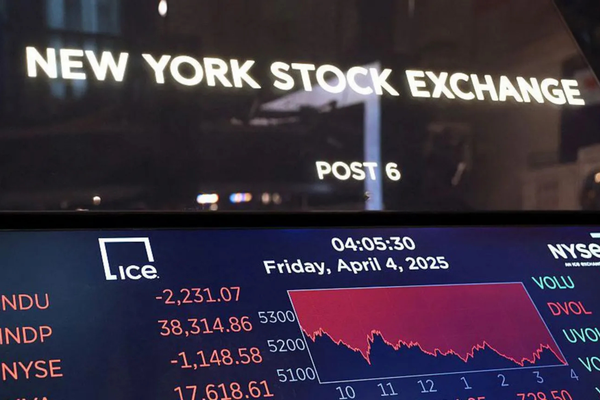
Global markets plunged on Friday, as China hit back at tariffs announced by US President Donald Trump, raising the likelihood of an extended trade war and damage to the global economy.
All three major stock indexes in the US plunged more than 5%, with the S&P 500 dropping almost 6%, capping the worst week for the US stock market since 2020.
In the UK, the FTSE 100 plunged almost 5% - its steepest fall in five years, while Asian markets also dropped and exchanges in Germany and France faced similar declines.
Trump, who has vowed to remake the global trade order, dismissed concerns about the market shock, noting that the US labour market is strong.
"Hang tough," he urged his followers on social media. "We can't lose."
The global stock market has lost trillions in value since Trump announced sweeping new 10% import taxes on goods from every country, with products from dozens of countries, including key trading partners such as China, the European Union and Vietnam, facing far higher rates.
Analysts say the moves, some of which are due to go into effect as soon as Saturday, amount to the biggest tax increase in the US since 1968.
They expect the measures to lead to a contraction in trade, and have warned they could drive many countries into an economic recession.
China responded to Trump on Friday by hitting US goods with import taxes of 34%, curbing exports of key minerals and adding American firms to its blacklist, describing Trump's actions as "bullying" and a violation of international trade rules.
Other countries appear to be hoping they will be able to negotiate deals, despite conflicting signals from the White House about its appetite for talks.
Maroš Šefčovič, the trade commissioner for the EU, which has been planning to retaliate, said on Friday that he had had a "frank" two-hour exchange with US officials, and wrote on social media the trade relationship needed a "fresh approach".
"The EU's committed to meaningful negotiations, but also prepared to defend our interests," he said. "We stay in touch."
Trump's moves are consistent with promises he made on the campaign trail last year.
But they were more far-reaching than some analysts had expected, triggering the worst week for the stock market since 2020, when the Covid-19 pandemic led to global shutdowns and other disruption.
The sell-off started with firms such as Apple and Nike, which rely heavily on suppliers in Asia. But on Friday, it moved into sectors that would typically not face the direct impact of tariffs, such as consumer staples, healthcare and utilities.
"Candidly the mood is pretty sour and it should be," said Mike Dickson, head of research and quantitative strategies at Horizon Investments in the US, warning that it will take weeks to understand the impact of Trump's tariffs.
"What we're really worried about right now is what we saw at 6am-ish [when China retaliated]," he said, "How much more of that is out there?"
In a note to investors, JP Morgan said it now put the odds of a global economic recession this year at 60%, up from 40% previously, noting that the shock from the tariffs could drive growth in the US down by two percentage points this year.
Some investors downplayed the losses, noting that they follow an astonishing run-up in the value of share prices in the US over the past few years.
"These shifts in the market that we're seeing - they're violent because things go down a lot quicker than they go up," said Tim Pagliara, chief executive of Tennessee-based CapWealth.
He said the White House was attempting a "big reset" in global trade but the effort was needed.
"We've talked about trade imbalance my entire career," he said. "Nothing's ever happened. So something has to happen.
"We are going to level the playing field on some of these relationships that have just gotten out of balance."
Speaking on Friday, Jerome Powell, the head of the Federal Reserve, the US central bank, said he thought the economy remained "solid", pointing to the latest data showing strong hiring in the US in March.
But he acknowledged a high degree of uncertainty.
"What we've learned is that the tariffs are higher than anticipated, higher than almost all forecasters predicted," Mr Powell said, warning that growth would slow and prices were likely to rise.

In New Jersey, small business owner Pat Muscaritolo, said the changes may force him to shut down his appliance shop, Jacobson Appliance, after 40 years in business. He has been urging customers to make any necessary purchases now.
"We don't know what the price is going to be at the end of the month," he said, though he is bracing for prices on items such as refrigerators that could be 30% or even 40% higher.
On the markets, housing-related firms were a bright spot, perhaps rallying on bets that the turmoil could lead to lower interest rates for mortgages and help the US housing market.
Shares in Nike, and other clothing retailers, which had been hammered on Thursday, also clawed back some ground on Friday, buoyed by hopes of a deal after Trump said he had a "very productive call" with the leader of Vietnam.
Cambodia also sent a letter offering to reduce tariffs and asking the US to negotiate.
But other parts of the market remained bleak.
Shares in Apple, which relies heavily on China for manufacturing, fell more than 7% on Friday. The iPhone maker's market value has dropped roughly 15% since Wednesday.
As the rout continued, even some White House allies started to criticise the measures.
On a podcast devoted to tariffs, Republican Senator Ted Cruz of Texas said Trump's moves could lead to benefits for the US, while warning of "enormous risks".
"If we're in a scenario 30 days from now, 60 days from now, 90 days from now, with massive American tariffs, and massive tariffs on American goods in every other country on earth, that is a terrible outcome," he said.
In the Falkland Islands, an archipelago in the South Atlantic Ocean, Janet Robertson, the general manager of Consolidated Fishing Limited, was wondering how a new 42% tax on its exports to the US would hit its sales of toothfish.
"At the moment, we're not making any dramatic decisions," she said.
But, she added, fishing is "by far the most important industry in the Falklands".
"The sales of toothfish into the States are a big part of that," she said.
"We're wondering where it will all end up."