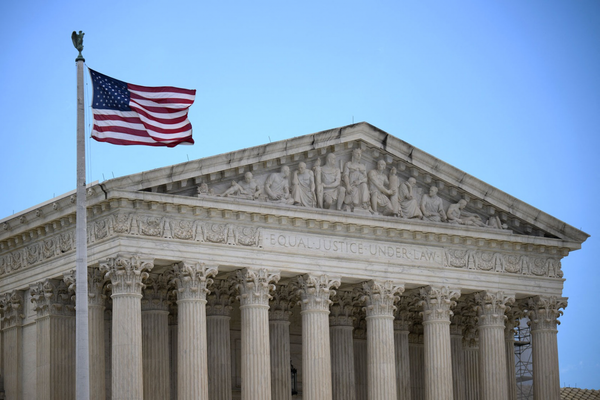
The Supreme Court on Wednesday denied the Trump administration's request to block a lower court's order for the administration to pay nearly $2 billion in foreign aid money, delivering a near-term reprieve to international aid groups and contractors seeking payment for previously completed projects.
In a 5-4 ruling, the justices said that the Feb. 26 deadline imposed by a lower court for the Trump administration to pay the funds had already expired and directed the case back to the district court to clarify any additional details on payment.
"Given that the deadline in the challenged order has now passed, and in light of the ongoing preliminary injunction proceedings, the District Court should clarify what obligations the Government must fulfill to ensure compliance with the temporary restraining order, with due regard for the feasibility of any compliance timelines," the Court said.
U.S. District Judge Amir Ali, for his part, moved quickly Wednesday to take action on the matter – ordering both parties to appear in court Thursday to consider plausible repayment schedules.
In a minute order, the court said lawyers for both parties should come prepared to discuss a proposed schedule for the Trump administration to comply with its outstanding payments.
The proposed schedules, the order noted, "should account for the length of time that has passed since the TRO, [temporary restraining order] was entered and the feasibility of any compliance timelines."
"The parties should also be prepared to discuss the steps Defendants have taken to come into compliance with the Court's orders, including any further steps that were executed following the parties' joint status report, as well as the parties' proposed schedule for Defendants coming into compliance."
Justices Clarence Thomas, Samuel Alito, Neil Gorsuch and Brett Kavanaugh dissented.
"Does a single district-court judge who likely lacks jurisdiction have the unchecked power to compel the Government of the United States to pay out (and probably lose forever) 2 billion taxpayer dollars? The answer to that question should be an emphatic ‘No,’ but a majority of this Court apparently thinks otherwise," Alito wrote. "I am stunned."
Chief Justice John Roberts agreed on Feb. 26 to temporarily pause a lower court’s decision requiring the Trump administration to pay by 11:59 p.m. all outstanding invoices to foreign aid groups, an amount totaling roughly $1.9 billion — a timeline the Justice Department had argued was "impossible" to comply with. Roberts did not give a reason for agreeing to pause the order issued by U.S. District Judge Amir Ali, a Biden appointee, though the chief justice had widely been expected to refer the matter to the full court for review.
Still, the decision to send the case back to the lower court to hash out what, exactly, must be paid out by the Trump administration — and when — could allow Trump officials to further stall on repayment.
Foreign aid groups had argued last week that Roberts' pause prevented them from filing a motion of civil contempt against the Trump administration, a legal maneuver that employees from the affected groups said in interviews this week could have expedited their process to claw back the unpaid debt.
At issue is how quickly the Trump administration needs to pay the nearly $2 billion owed to aid groups and contractors for completed projects funded by the U.S. Agency for International Development (USAID), at a time when the administration has issued a blanket freeze on all foreign spending in the name of government "efficiency" and eliminating waste.
In a new court filing Monday, Acting U.S. Solicitor General Sarah Harris said that while the plaintiffs' claims were likely "legitimate," the time U.S. District Judge Amir Ali gave them to pay the outstanding invoices was "not logistically or technically feasible."
Harris also argued Monday that the order could be a violation of executive branch authorities granted by the Constitution to an elected president.
Ordering the Trump administration to make payments on a timeline of the lower court’s choosing, and "without regard to whether the requests are legitimate, or even due yet," Harris said, "intrudes on the president’s foreign affairs powers" and executive branch oversight when it comes to distributing foreign aid.
Plaintiffs, for their part, rejected that notion in full. They argued in their own Supreme Court filing that the lower court judge had ordered the Trump administration to begin making the owed foreign aid payments more than two weeks ago — a deadline they said the government simply failed to meet, or to even take steps to meet — indicating that the administration had no plans to make good on fulfilling that request.
The Trump administration "never took steps towards compliance" with Ali's order requiring the administration to unfreeze the federal funds to pay the $1.9 billion in owed project payments, attorneys for plaintiffs argued in their own Supreme Court filing.
They also rejected the administration's assertion in court last week that it would need "multiple weeks" to restart the payment system.
Rather, they said, the Trump administration had moved too quickly to dismantle the systems required to send payments to foreign aid groups in the first place — and to purge the many USAID staffers who could have facilitated a smoother, faster repayment process.
"All of these invoices have already been approved by the front-line managers at USAID, and it's really these payment bottlenecks that the government has itself created" that have caused the problems with repayment, one individual with knowledge of the USAID payments and contractors affected told Fox News Digital in an interview.
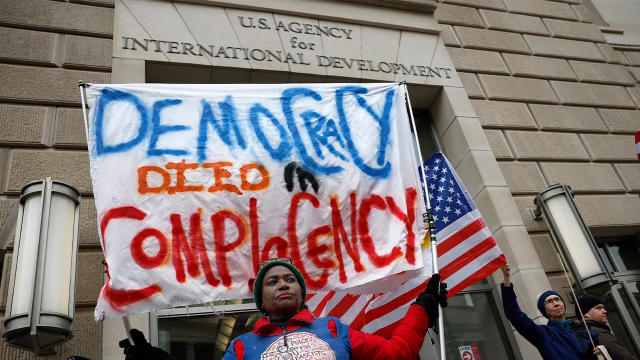
The high court challenge comes as many of the foreign aid groups who sued the administration earlier this year have already been stripped of the bulk of their funding. This aligns with President Donald Trump's stated plans to cut some 90% of USAID foreign aid contracts and to slash an additional $60 billion in foreign aid spending.
The White House has not yet released a list of which contracts and grants were scheduled for elimination or those to be continued. However, critics have argued that the abrupt withdrawal of U.S. investment and presence around the world risks economic harm, reputational damage and new security risks, both at home and abroad.
Scott Greytak, a director at the group U.S. Transparency International, said in a statement that cutting such a large amount of U.S. foreign aid carries significant economic and security risks. The elimination of U.S. funding for certain projects, especially in countries with higher risks of corruption, could "open the door for increased cross-border corruption, fraud, and other crimes," he said.
This could create new obstacles for U.S. businesses seeking to open or expand into foreign markets, said Greytak, whose group has active chapters in more than 100 countries globally, and could serve "as an invitation for U.S. competitors, especially China, to fill the vacuum created by the absence of U.S. engagement."